
The Serengeti is extraordinary year-round — but timing your visit changes everything. Here's exactly what to expect every single month of the year.
The short answer is: any month. The Serengeti is one of those rare places where the wildlife is extraordinary in every season. The longer answer is that different months deliver entirely different experiences — and knowing what each one offers lets you choose the visit that matches your specific interests, whether that is predator action, river crossings, calving plains, or simply avoiding crowds.
Understanding Serengeti Seasons
Tanzania has two rainy seasons — the long rains from March to May and the short rains in November. Between them sit two dry seasons: the main dry season from June to October, and a shorter dry spell in January and February. These rainfall patterns dictate where the grass grows, which determines where the wildebeest herds concentrate, which in turn drives predator distribution. Understanding this cycle is the key to planning your visit.
The Serengeti covers 14,763 square kilometres — an area larger than Northern Ireland — and the different zones within it play host to different phases of the migration at different times of year. The southern plains around Ndutu see the calving herds from December to March. The central Serengeti hosts the herds as they move north from April to June. The western corridor sees Grumeti River crossings in June. The northern Serengeti near the Mara River is the scene of the famous crossings from July to October.
Month-by-Month Breakdown
January and February — Calving Season
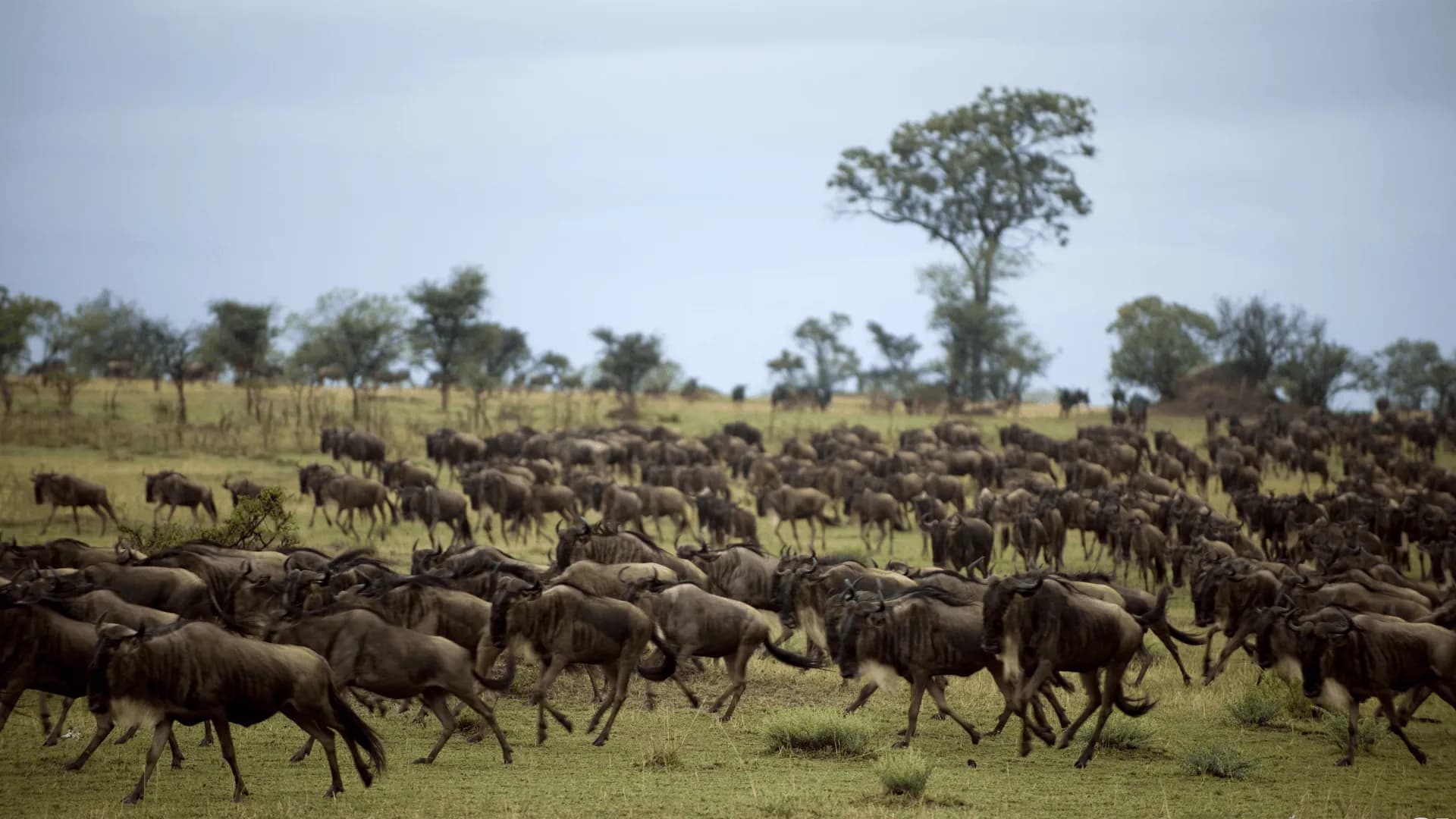
January and February are two of the finest months to visit the Serengeti. The short rains have ended and the southern plains around Ndutu are carpeted with fresh green grass that draws the wildebeest herds in their hundreds of thousands. This is calving season — the single most dramatic concentration of predator and prey interactions in Africa. Up to 8,000 calves are born every day at the peak, and the predators — lion, cheetah, hyena, leopard, wild dog — arrive to feast. Prices are relatively low, the rains are done, and the birdlife is at its peak thanks to the presence of migratory species from Europe and Asia.
March to May — Green Season
The long rains arrive in March, bringing an astonishing transformation to the Serengeti. The grass turns deep green, wildflowers bloom, the sky fills with dramatic storm clouds, and the landscape looks completely different from the dry-season photos you have likely seen. The wildebeest herds begin moving north as the southern rains ease, and the central Serengeti fills with animals. Lodge rates drop by 20–40%, many camps close for maintenance, and the parks are significantly less crowded. Game viewing is still excellent — in fact, some experienced safari-goers prefer March through May for the photography opportunities and the solitude.
June — Transition and Grumeti Crossings
June marks the beginning of the main dry season and the arrival of the herds in the western corridor. The Grumeti River — home to a population of enormous, ancient Nile crocodiles — sees its own dramatic crossings in June, and this is often overlooked in favour of the more famous Mara River. The grass dries and the animals begin concentrating around water sources, making game viewing increasingly reliable. Prices are lower than July and August, and the parks are noticeably quieter.
July and August — Peak Season, Mara River Crossings
July and August are the most popular months to visit the Serengeti — and for good reason. The herds have moved into the northern Serengeti and are crossing the Mara River in one of the most dramatic wildlife events on the planet. Tens of thousands of wildebeest launch themselves into crocodile-filled waters in crossings that can happen multiple times a day. The dry-season landscape makes wildlife easy to spot, the skies are clear, and the game viewing is at its most reliable. The trade-offs are higher prices, more vehicles at prime spots, and fully booked camps at the good locations.
September and October — Transition Back South
The herds move back south through the northern Serengeti in October, triggering reverse Mara River crossings that are often quieter but equally dramatic. September is excellent for game viewing in the northern Serengeti, and many experienced travellers prefer it to August because the crowds thin slightly while the wildlife remains concentrated. October sees the herds spreading south again, and the short rains typically begin in late October or November, refreshing the landscape.
November and December — Short Rains and New Beginnings
November brings the short rains, usually lasting three to four weeks. Game viewing remains good, and the lower prices make this a strong value proposition. December sees the rains ease, the southern plains begin greening, and the first heavily pregnant wildebeest arrive ahead of the calving season. The Serengeti in December has a sense of anticipation — the cycle is completing, and the plains are filling again.
Best All-Round Month
If forced to choose a single month, most experienced guides recommend February. Calving season is at its peak, predator activity is extraordinary, prices are reasonable, and the landscape is green and photogenic. June is the best value month for those wanting dry-season game viewing without July and August crowds.
When Are Prices Lowest?
The long rain period — April and May — offers the lowest prices of the year, sometimes 30–40% below peak rates. November is also lower than peak. These months are excellent for budget-conscious travellers willing to accept that some camps close and the roads can be muddy. The wildlife reward for visiting in the green season is often underestimated — the landscape is beautiful, the birds are spectacular, and the predator activity is year-round.
When Are Parks Most Crowded?
July and August see the highest visitor numbers in the Serengeti, particularly in the northern zone near the Mara River. At the most popular river crossing points, a dozen or more vehicles can gather — a far cry from the solitary experience many visitors imagine. Choosing a private vehicle and a camp positioned away from the main crossing hotspots helps significantly. Your guide's knowledge of lesser-visited viewpoints can make the difference between a crowded spectacle and a private encounter.
The best month to visit the Serengeti is the one that aligns with what matters most to you — and that requires an honest conversation about your priorities. Tell your operator whether you want calving season, river crossings, lower prices, greener landscapes, or maximum solitude. The Serengeti delivers on all of them, just at different times of year.
Which Part of the Serengeti to Visit
- ›Southern Serengeti (Ndutu area): best December–March for calving and predator action
- ›Central Serengeti (Seronera): reliable year-round, especially good for resident lion and leopard
- ›Western Corridor (Grumeti): best June for Grumeti River crossings
- ›Northern Serengeti (Kogatende/Lamai): best July–October for Mara River crossings
Serengeti vs Other Tanzania Parks
The Serengeti is Tanzania's most famous park but not the only extraordinary one. Tarangire National Park south of the Serengeti has the highest elephant density in East Africa and exceptional birdlife. Ngorongoro Crater, just east of the Serengeti, is the world's largest intact volcanic caldera and holds 25,000 animals in a self-contained ecosystem including the endangered black rhino. Most Tanzania itineraries combine two to three parks — and the Serengeti is almost always the centrepiece.
Getting to the Serengeti is straightforward. Most visitors fly into Kilimanjaro International Airport (JRO) near Arusha, drive or fly to the park, and base themselves at a camp for three to six nights. Internal flights between Arusha and Serengeti airstrips take 45 minutes and offer stunning views. Road transfers through the Ngorongoro Conservation Area are spectacular but take four to five hours. Most itineraries combine both — flying in, driving out (or vice versa) — to cover the landscape twice.
Based in Arusha, Tanzania
Ready to Experience It First-Hand?
Our expert team creates custom itineraries for every budget and timeframe. Get your personalised quote within 24 hours.