
The Ngorongoro Crater is a 260 km² natural enclosure sheltering 25,000 animals — including the endangered black rhino. Here's your complete guide to visiting.
The Ngorongoro Crater is the world's largest intact volcanic caldera, a 260 km² bowl sunk 600 metres below the surrounding crater rim. Inside it live 25,000 animals — lion, elephant, hippo, hyena, zebra, wildebeest, buffalo, flamingo, and the critically endangered black rhinoceros — in a self-contained ecosystem so complete that almost none of the animals ever leaves. Visiting Ngorongoro is not like visiting other parks. It is like entering a natural amphitheatre where the walls are forested mountains and the stage is one of the most extraordinary wildlife stages on Earth.
Geography and Formation
Ngorongoro formed approximately 2.5 million years ago when a large volcano — estimated to have been as tall as Kilimanjaro — collapsed inward after a series of eruptions. The resulting caldera is roughly 18 km across at its widest point, ringed by forested walls that rise 400–600 metres above the crater floor. The floor itself contains a complex of habitats: open grassland, acacia woodland, the Lerai Forest, the Gorigor Swamp, and Lake Magadi — a shallow soda lake in the southwestern corner that attracts thousands of flamingo.
Wildlife on the Crater Floor
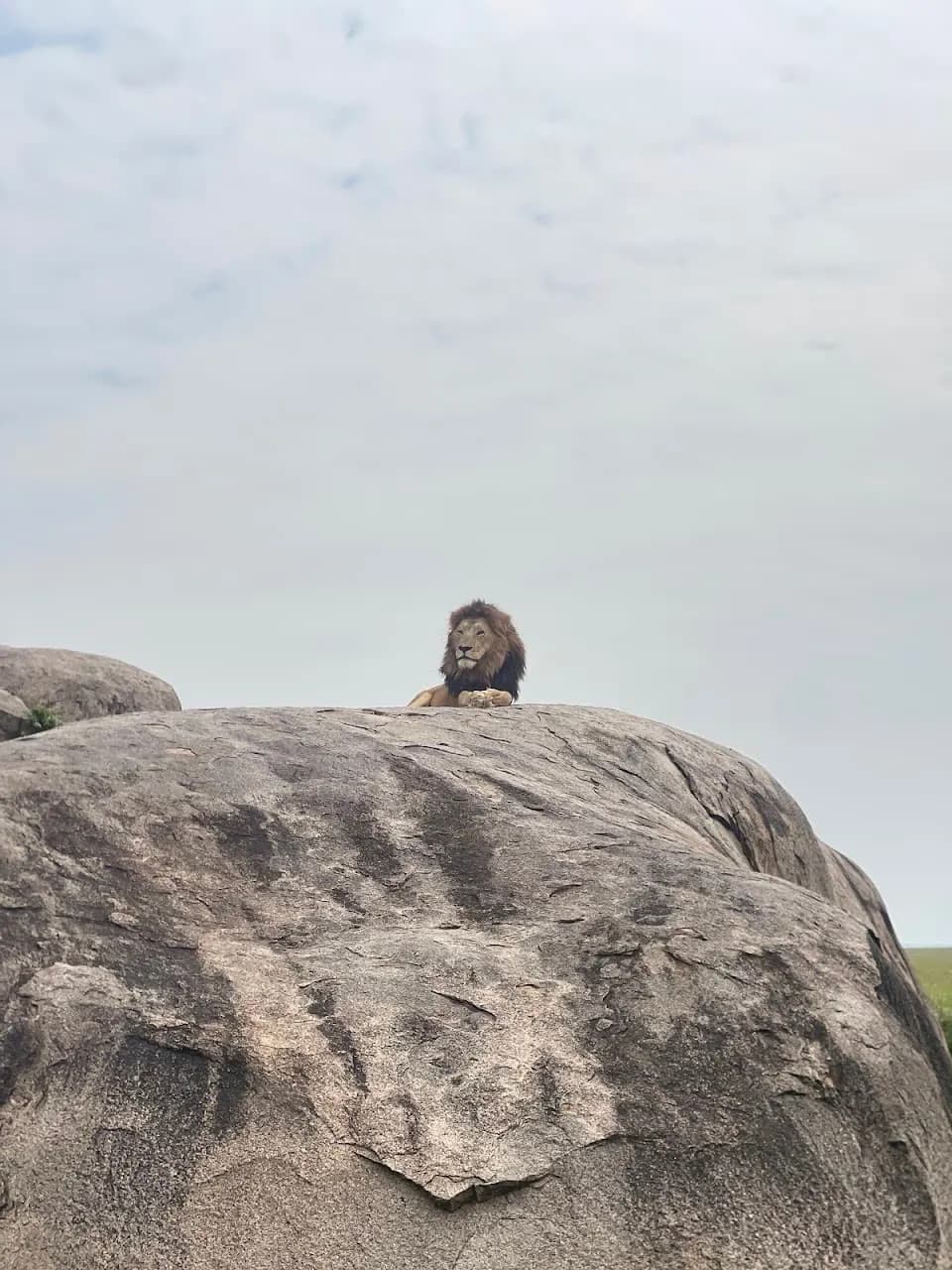
Ngorongoro's wildlife density is extraordinary — not because the crater contains unusual species, but because the contained geography concentrates them. Lions are present in high numbers, and Ngorongoro's lion prides are famous: some of the largest prides in East Africa live here, and the lions are so habituated to vehicles that you can observe them at ranges of two to five metres. The lion gene pool within the crater is largely isolated from outside prides, which has created some visible physical characteristics in the local lions including unusually full manes in the males.
Elephants in the crater are predominantly large, old bulls — the matriarch-led family groups tend to range across the crater rim and down into the forests above the floor. The bulls that remain on the crater floor year-round are some of the most impressive in East Africa: ancient, massive, with enormous tusks that represent decades of protected living inside the conservation area. The Ngorongoro Conservation Area Authority (NCAA) maintains strict anti-poaching patrols, and the results are visible in the condition of the animals.
The Black Rhinoceros
Ngorongoro's approximately 25 black rhinos represent one of the most important and most carefully protected populations in East Africa. The black rhino is critically endangered — fewer than 6,000 survive in the wild globally, and the Ngorongoro population is managed as a genetically significant sub-population. Sightings are not guaranteed, but this is one of the most reliable places in Africa to see black rhino in the wild.
The best strategy for rhino viewing is to arrive on the crater floor at opening time (7:00 AM) and make straight for the Ngoitokitok Springs and Mandusi Swamp areas on the eastern crater floor — the most consistent rhino territory. Stay patient: rhinos in the Ngorongoro are not heavily habituated to vehicles and may move away quickly. Having binoculars makes a significant difference — your guide may spot the rhino from a distance before bringing you in for a better look.
Visiting the Crater: Logistics
Access to the Ngorongoro Crater floor is strictly controlled by the NCAA. Vehicles enter via the Seneto descent road and exit via the Lerai ascent road — one-way only. A maximum of approximately 500 vehicles per day are permitted on the crater floor, and the crater is closed to vehicles from dusk to dawn. Game drives on the crater floor typically last five to six hours, and most itineraries allocate a full day for the Ngorongoro.
All vehicles must be closed 4x4s — open-top vehicles are not permitted on the crater floor (the sides can be raised, but the roof must be capable of being closed). This is a wildlife safety rule: lions on the Ngorongoro floor are close enough to vehicles that an open-sided 4x4 would create an unacceptable risk. Your operator's vehicles will comply automatically if they are legitimately licensed.
Full Day vs Half Day
A half-day on the crater floor is not enough. The Ngorongoro deserves a full day: arrive at opening, spend the full morning in the prime wildlife areas, picnic at the Ngoitokitok hippo pool, and explore the southwestern flamingo lake in the afternoon. Departing before 3 PM means missing the afternoon predator activity.
The Crater Rim
The Ngorongoro Conservation Area extends well beyond the crater floor. The crater rim itself sits at approximately 2,300 metres and is cold, misty, and forested — a dramatic contrast to the warm floor below. Rim lodges offer the extraordinary experience of waking up in the forest, stepping onto your veranda, and looking down into the crater across 600 metres of altitude difference. On clear mornings, the view from the rim is one of the most extraordinary in Africa — the entire natural amphitheatre spread below you, animals visible with binoculars on the crater floor.
Combining Ngorongoro with the Serengeti
Almost every Tanzania Northern Circuit itinerary combines Ngorongoro with the Serengeti — the two are separated by less than 100 km and complement each other perfectly. The Serengeti offers vast open plains and the Great Migration; Ngorongoro offers contained density and the rhino. Allocate a full day for the Crater and at least three nights in the Serengeti for the ideal combination. Some itineraries include Lake Manyara or Tarangire before moving to the main parks — three to four park circuits in seven days is the standard Northern Circuit format.
No photograph, no documentary, no description fully prepares you for the moment your vehicle descends the crater wall and the vast floor spreads out below you. The Ngorongoro is not a zoo — the animals are wild, the space is real, and the density of life in that 260 km² bowl is something that the human mind struggles to process until you are inside it. Plan at least a full day; two days is better.
Based in Arusha, Tanzania
Ready to Experience It First-Hand?
Our expert team creates custom itineraries for every budget and timeframe. Get your personalised quote within 24 hours.